Category: Papers

  • Building Neutron Stars with the MUSES Calculation Engine

    Building Neutron Stars with the MUSES Calculation Engine

    Exploring the Equation of State (EoS) of dense matter is an essential part of interpreting the observable properties of neutron stars. Our latest paper presents the first results for dense matter in the zero-temperature limit, generated by the first public release MUSES Calculation Engine (CE) -future releases are planned to expand the scope of available modules and their capabilities.

    The CE is built to model the EoS across the QCD phase diagram, covering the environment inside neutron stars and also those found in heavy ion collisions. To this end, the CE includes a variety of relevant models, some are focused on astrophysical computations while others are dedicated to heavy-ion collisions. The composable, multi-module workflows, allowing the user to connect modules and easily compute physical observables and process data.

    In this paper we focus on the neutron star EoS, and explore how different matching procedures using different thermodynamic variables affect neutron star properties, such as mass and radius, and universal relations. We combine three EoS modules:

    • Crust Density Functional Theory, valid starting at low densities.
    • Chiral Effective Field Theory, valid around saturation density.
    • Chiral Mean Field model, valid beyond saturation density.

    We create the workflows using, in addition to the EoS modules, the Lepton module to ensure charge neutrality and beta-equilibrium; the Synthesis module, to match the three equations of state using different thermodynamic variables and different methods; and the QLIMR module, a novel full-general-relativity solver, that calculates neutron star properties.

    Moreover, we use the Flavor Equilibration module to estimate bulk viscosity and flavor relaxation charge fraction and rates (at low temperature) for Chiral Effective Field Theory and the Chiral Mean Field model.

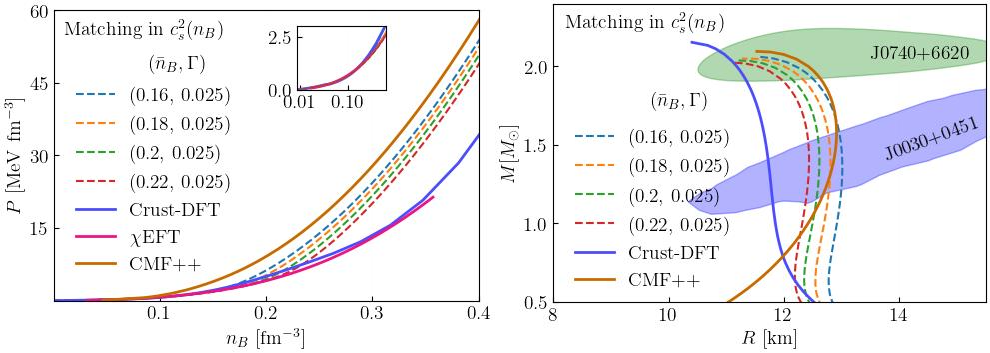
    Our investigation highlights how the choice of the matching variable can influence the resulting EoS and, consequently, the astrophysical observables. While naive matching of EoSs might introduce artificial features such as unphysical structures in the speed of sound or large artificial first-order phase transitions, we used methods that either remove or keep to a minimum such artificial features. This allows us to devise thermodynamically consistent crust-to-core EoSs. In Fig. 1 we show the matched EoS in the speed of sound squared as a function of the baryon density, the original ones and their respective mass-radius curves.

    We find that the radii of neutron stars are the most affected observable, with a total variation of ΔR* 1.4 M⊙=9.21% when considering all matching methods. The maximum mass, on the other hand, has a variation of 3.73%. Additionally, the universal I-Love-Q relations remain robust.

    The release of the CE lays the groundwork for future studies where nuclear theorists, gravitational-wave physicists, astrophysicists, and experimentalists can directly sample nuclear physics parameters. Instead of relying solely on phenomenological toy models, researchers will soon be able to constrain the EoS using combined observational data from gravitational waves, X-ray emissions, and heavy-ion collisions.

    All the code used in this work is public, and it can be found at our Zenodo community. The Calculation Engine website can be accessed here: https://ce.musesframework.io/.

    Title

    Building Neutron Stars with the MUSES Calculation Engine

    Authors

    Mateus Reinke Pelicer, Nikolas Cruz-Camacho, Carlos Conde-Ocazionez, David Friedenberg, Satyajit Roy, Ziyuan Zhang, T. Andrew Manning, Mark G. Alford, Alexander Clevinger, Joaquin Grefa, Roland Haas, Alexander Haber, Mauricio Hippert, Jeremy W. Holt, Johannes Jahan, Micheal Kahangirwe, Rajesh Kumar, Jeffrey Peterson, Hitansh Shah, Andrew W. Steiner, Hung Tan, Yumu Yang, Volodymyr Vovchenko, Veronica Dexheimer, Jorge Noronha, Jaquelyn Noronha-Hostler, Claudia Ratti, Nicolás Yunes

    Abstract

    Exploring the equation of state of dense matter is an essential part of interpreting the observable properties of neutron stars. We present here the first results for dense matter in the zero-temperature limit generated by the MUSES Calculation Engine, a composable workflow management system that orchestrates calculation and data processing stages comprising a collection of software modules designed within the MUSES framework.
    The modules presented in this work calculate equations of state using algorithms spanning three different theories/models: (1) Crust Density Functional Theory, valid starting at low densities, (2) Chiral Effective Field Theory, valid around saturation density, and (3) the Chiral Mean Field model, valid beyond saturation density.

    Lepton contributions are added through the Lepton module to each equation of state, ensuring charge neutrality and the possibility of β-equilibrium.

    Using the Synthesis module, we match the three equations of state using different thermodynamic variables and different methods. We then couple the complete equation of state to a novel full-general-relativity solver (QLIMR) module that calculates neutron star properties.

    We find that the matching performed using different thermodynamic variables affects differently the range obtained for neutron star masses and radii (although never beyond a few percent difference). We also investigate the universality of equation of state-independent relations for our matched stars. Finally, for the first time, we use the Flavor Equilibration module to estimate bulk viscosity and flavor relaxation charge fraction and rates (at low temperature) for Chiral Effective Field Theory and the Chiral Mean Field model.

    BibTeX

    @article{ReinkePelicer:2025vuh, 
    author = "Reinke Pelicer, Mateus and others", 
    title = "{Building Neutron Stars with the MUSES Calculation Engine}", 
    eprint = "2502.07902", 
    archivePrefix = "arXiv", 
    primaryClass = "nucl-th", 
    month = "2",
    year = "2025" }
    
    
  • Modern nuclear and astrophysical constraints of dense matter in a redefined chiral approach

    Modern nuclear and astrophysical constraints of dense matter in a redefined chiral approach

    Published on April 01, 2024

    Title

    Modern nuclear and astrophysical constraints of dense matter in a redefined chiral approach

    Authors

    Rajesh Kumar, Yuhan Wang, Nikolas Cruz Camacho, Arvind Kumar, Jacquelyn Noronha-Hostler, Veronica Dexheimer

    Abstract

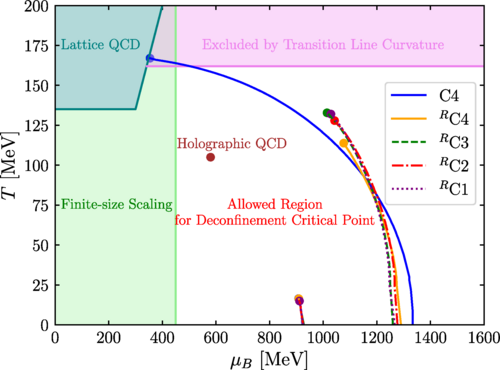
    We explore the quantum chromodynamics (QCD) phase diagram’s complexities, including quark deconfinement transitions, liquid-gas phase changes, and critical points by using the chiral mean-field (CMF) model that is able to capture all these features. We introduce a vector meson field redefinition within the CMF framework, enabling precise adjustments of meson masses and coupling strengths related to vector meson interactions. Performing a new fit to the deconfinement potential, we are able to replicate recent lattice QCD results, low-energy nuclear physics properties, neutron star observational data, and key phase diagram features as per modern constraints. This approach enhances our understanding of vector mesons’ roles in mediating nuclear interactions and their impact on the equation of state, contributing to a more comprehensive understanding of the QCD phase diagram and its implications for nuclear and astrophysical phenomena.

    BibTeX

    @article{Kumar:2024owe, author = "Kumar, Rajesh and Wang, Yuhan and Camacho, Nikolas Cruz and Kumar, Arvind and Noronha-Hostler, Jacquelyn and Dexheimer, Veronica",
    title = "{Modern nuclear and astrophysical constraints of dense matter in a redefined chiral approach}",
    eprint = "2401.12944", 
    archivePrefix = "arXiv",
    primaryClass = "nucl-th",
    doi = "10.1103/PhysRevD.109.074008",
    journal = "Phys. Rev. D", 
    volume = "109", 
    number = "7",
    pages = "074008", 
    year = "2024" }


  • Hot QCD phase diagram from holographic Einstein–Maxwell–Dilaton models

    Published on November 30, 2023

    Title

    Hot QCD phase diagram from holographic Einstein–Maxwell–Dilaton models

    Authors

    Romulo Rougemont, Joaquin Grefa, Mauricio Hippert, Jorge Noronha, Jacquelyn Noronha-Hostler, Israel Portillo, Claudia Ratti

    Abstract

    In this review, we provide an up-to-date account of quantitative bottom-up holographic descriptions of the strongly coupled quark–gluon plasma (QGP) produced in relativistic heavy-ion collisions, based on the class of gauge-gravity Einstein–Maxwell–Dilaton (EMD) effective models. The holographic approach is employed to tentatively map the QCD phase diagram at finite temperature onto a dual theory of charged, asymptotically Anti-de Sitter (AdS) black holes living in five dimensions. With a quantitative focus on the hot QCD phase diagram, the nonconformal holographic EMD models reviewed here are adjusted to describe first-principles lattice results for the finite-temperature QCD equation of state, with 2+1 flavors and physical quark masses, at zero chemical potential and vanishing electromagnetic fields. We review the evolution of such effective models and the corresponding improvements produced in quantitative holographic descriptions of the deconfined hot QGP phase of QCD. The predictive power of holographic EMD models is tested by quantitatively comparing their predictions for the hot QCD equation of state at nonzero baryon density and the corresponding state-of-the-art lattice QCD results. Hydrodynamic transport coefficients such as the shear and bulk viscosities predicted by these EMD constructions are also compared to the corresponding profiles favored by the latest phenomenological multistage models simultaneously describing different types of heavy-ion data. We briefly report preliminary results from a Bayesian analysis using EMD models, which provide systematic evidence that lattice QCD results at finite temperature and zero baryon density strongly constrains the free parameters of such bottom-up holographic constructions. Remarkably, the set of parameters constrained by lattice results at vanishing chemical potential turns out to produce EMD models in quantitative agreement with lattice QCD results also at finite baryon density. We also review results for equilibrium and transport properties from magnetic EMD models, which effectively describe the hot and magnetized QGP at finite temperatures and magnetic fields with zero chemical potentials. Finally, we provide a critical assessment of the main limitations and drawbacks of the holographic models reviewed in the present work, and point out some perspectives we believe are of fundamental importance for future developments.

    BibTeX

    @article{Rougemont:2023gfz,
        author = "Rougemont, Romulo and Grefa, Joaquin and Hippert, Mauricio and Noronha, Jorge and Noronha-Hostler, Jacquelyn and Portillo, Israel and Ratti, Claudia",
        title = "{Hot QCD phase diagram from holographic Einstein\textendash{}Maxwell\textendash{}Dilaton models}",
        eprint = "2307.03885",
        archivePrefix = "arXiv",
        primaryClass = "nucl-th",
        doi = "10.1016/j.ppnp.2023.104093",
        journal = "Prog. Part. Nucl. Phys.",
        volume = "135",
        pages = "104093",
        year = "2024"
    }


  • Bayesian location of the QCD critical point from a holographic perspective

    Bayesian location of the QCD critical point from a holographic perspective

    Submitted to ArXiV on September 1, 2023

    Title

    Bayesian location of the QCD critical point from a holographic perspective

    Authors

    Mauricio Hippert, Joaquin Grefa, T. Andrew Manning, Jorge Noronha, Jacquelyn Noronha-Hostler, Israel Portillo Vazquez, Claudia Ratti, Romulo Rougemont, Michael Trujillo

    Abstract

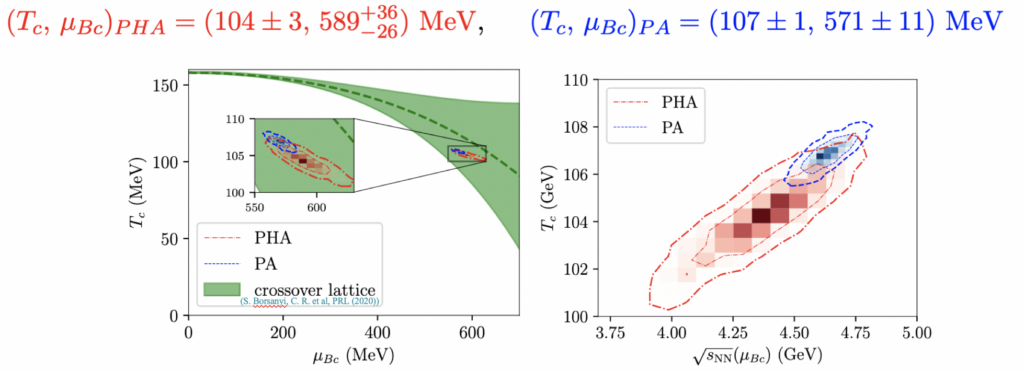
    A fundamental question in QCD is the existence of a phase transition at large doping of quarks over antiquarks. We present the first prediction of a QCD critical point (CP) from a Bayesian analysis constrained by first principle results at zero doping. We employ the gauge/gravity duality to map QCD onto a theory of dual black holes. Predictions for the CP location in different realizations of the model overlap at one sigma. Even if many prior samples do not include a CP, one is found in nearly 100% of posterior samples, indicating a strong preference for a CP.

    BibTeX

    @article{Hippert:2023bel,
        author = "Hippert, Mauricio and Grefa, Joaquin and Manning, T. Andrew and Noronha, Jorge and Noronha-Hostler, Jacquelyn and Portillo Vazquez, Israel and Ratti, Claudia and Rougemont, Romulo and Trujillo, Michael",
        title = "{Bayesian location of the QCD critical point from a holographic perspective}",
        eprint = "2309.00579",
        archivePrefix = "arXiv",
        primaryClass = "nucl-th",
        month = "9",
        year = "2023"
    }


  • Finite density QCD equation of state: critical point and lattice-based T′-expansion

    Finite density QCD equation of state: critical point and lattice-based T′-expansion

    Submitted to ArXiV on February 13, 2024

    Title

    Finite density QCD equation of state: critical point and lattice-based T′-expansion

    Authors

    Micheal Kahangirwe, Steffen A. Bass, Elena Bratkovskaya, Johannes Jahan, Pierre Moreau, Paolo Parotto, Damien Price, Claudia Ratti, Olga Soloveva, Mikhail Stephanov

    Abstract

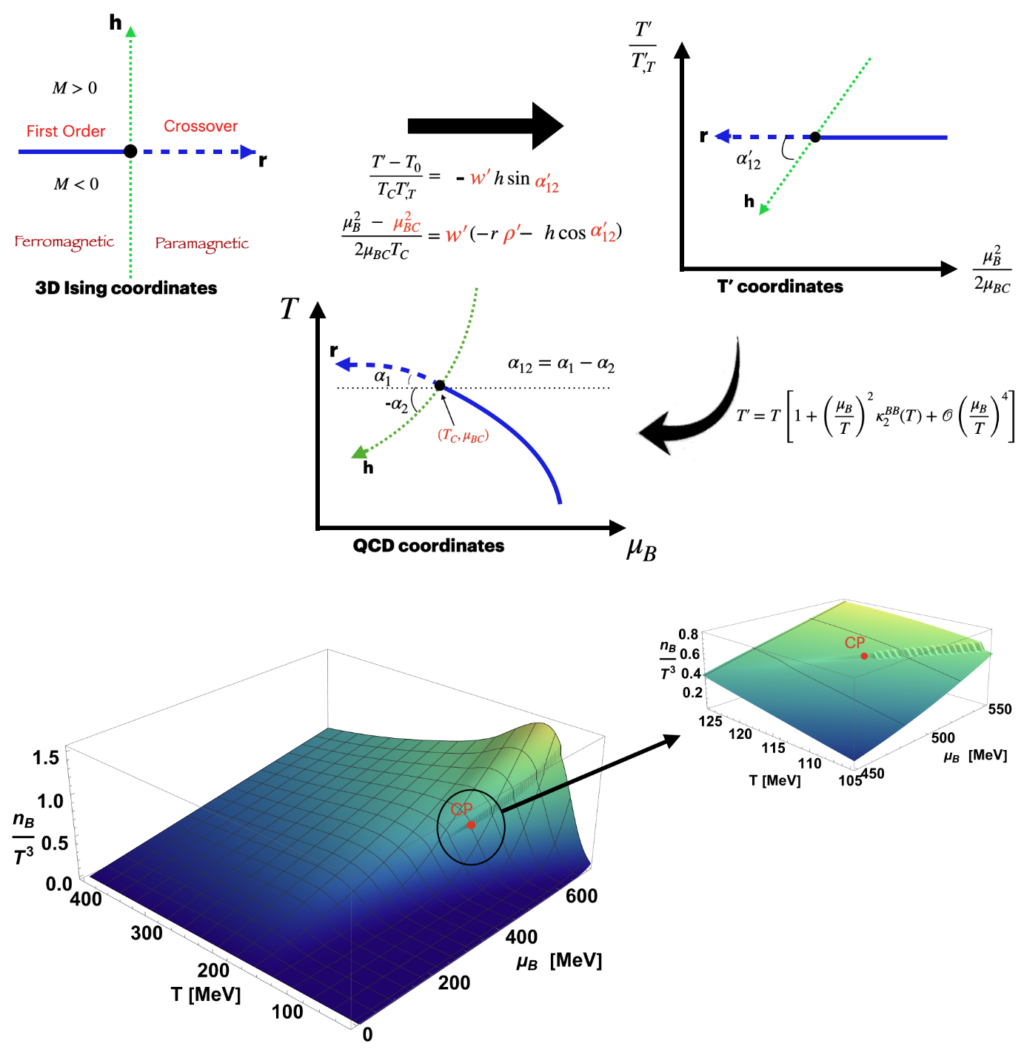
    We present a novel construction of the QCD equation of state (EoS) at finite baryon density. Our work combines a recently proposed resummation scheme for lattice QCD results with the universal critical behavior at the QCD critical point. This allows us to obtain a family of equations of state in the range 0≤μB≤700 MeV and 25≤T≤800 MeV, which match lattice QCD results near μB=0 while featuring a critical point in the 3D Ising model universality class. The position of the critical point can be chosen within the range accessible to beam-energy scan heavy-ion collision experiments. The strength of the singularity and the shape of the critical region are parameterized using a standard parameter set. We impose stability and causality constraints and discuss the available ranges of critical point parameter choices, finding that they extend beyond earlier parametric QCD EoS proposals. We present thermodynamic observables, including baryon density, pressure, entropy density, energy density, baryon susceptibility and speed of sound, that cover a wide range in the QCD phase diagram relevant for experimental exploration.

    BibTeX

    @article{Kahangirwe:2024cny,
        author = "Kahangirwe, Micheal and Bass, Steffen A. and Bratkovskaya, Elena and Jahan, Johannes and Moreau, Pierre and Parotto, Paolo and Price, Damien and Ratti, Claudia and Soloveva, Olga and Stephanov, Mikhail",
        title = "{Finite density QCD equation of state: critical point and lattice-based $T'$-expansion}",
        eprint = "2402.08636",
        archivePrefix = "arXiv",
        primaryClass = "nucl-th",
        month = "2",
        year = "2024"
    }


  • Thermodynamics of an updated hadronic resonance list and influence on hadronic transport

    Thermodynamics of an updated hadronic resonance list and influence on hadronic transport

    Submitted to arXiv on Sep 4 2023

    Title

    Thermodynamics of an updated hadronic resonance list and influence on hadronic transport

    Authors

    Jordi Salinas San Martín, Renan Hirayama, Jan Hammelmann, Jamie M. Karthein, Paolo Parotto, Jacquelyn Noronha-Hostler, Claudia Ratti, Hannah Elfner

    Abstract

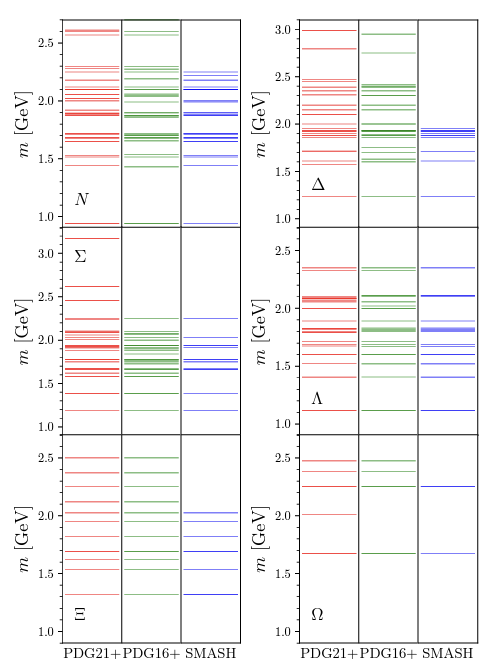
    Hadron lists based on experimental studies summarized by the Particle Data Group (PDG) are a crucial input for the equation of state and thermal models used in the study of strongly-interacting matter produced in heavy-ion collisions. Modeling of these strongly-interacting systems is carried out via hydrodynamical simulations, which are followed by hadronic transport codes that also require a hadronic list as input. To remain consistent throughout the different stages of modeling of a heavy-ion collision, the same hadron list with its corresponding decays must be used at each step. It has been shown that even the most uncertain states listed in the PDG from 2016 are required to reproduce partial pressures and susceptibilities from Lattice Quantum Chromodynamics with the hadronic list known as the PDG2016+. Here, we update the hadronic list for use in heavy-ion collision modeling by including the latest experimental information for all states listed in the Particle Data Booklet in 2021. We then compare our new list, called PDG2021+, to Lattice Quantum Chromodynamics results and find that it achieves even better agreement with the first principles calculations than the PDG2016+ list. Furthermore, we develop a novel scheme based on intermediate decay channels that allows for only binary decays, such that PDG2021+ will be compatible with the hadronic transport framework SMASH. Finally, we use these results to make comparisons to experimental data and discuss the impact on particle yields and spectra.

    BibTeX

    @article{SalinasSanMartin:2023idj,
        author = "Salinas San Mart\'\i{}n, Jordi and Hirayama, Renan and Hammelmann, Jan and Karthein, Jamie M. and Parotto, Paolo and Noronha-Hostler, Jacquelyn and Ratti, Claudia and Elfner, Hannah",
        title = "{Thermodynamics of an updated hadronic resonance list and influence on hadronic transport}",
        eprint = "2309.01737",
        archivePrefix = "arXiv",
        primaryClass = "nucl-th",
        month = "9",
        year = "2023"
    }

  • Theoretical and Experimental Constraints for the Equation of State of Dense and Hot Matter

    Theoretical and Experimental Constraints for the Equation of State of Dense and Hot Matter

    Published on June 05, 2024

    Title

    Theoretical and Experimental Constraints for the Equation of State of Dense and Hot Matter

    Authors

    Rajesh Kumar, Veronica Dexheimer, Johannes Jahan, Jorge Noronha, Jacquelyn Noronha-Hostler, Claudia Ratti, Nico Yunes, Angel Rodrigo Nava Acuna, Mark Alford, Mahmudul Hasan Anik, Debarati Chatterjee, Katerina Chatziioannou, Hsin-Yu Chen, Alexander Clevinger, Carlos Conde, Nikolas Cruz-Camacho, Travis Dore, Christian Drischler, Hannah Elfner, Reed Essick, David Friedenberg, Suprovo Ghosh, Joaquin Grefa, Roland Haas, Alexander Haber, Jan Hammelmann, Steven Harris, Carl-Johan Haster, Tetsuo Hatsuda, Mauricio Hippert, Renan Hirayama, Jeremy W. Holt, Micheal Kahangirwe, Jamie Karthein, Toru Kojo, Philippe Landry, Zidu Lin, Matthew Luzum, Timothy Andrew Manning, Jordi Salinas San Martin, Cole Miller, Elias Roland Most, Debora Mroczek, Azwinndini Muronga, Nicolas Patino, Jeffrey Peterson, Christopher Plumberg, Damien Price, Constanca Providencia, Romulo Rougemont, Satyajit Roy, Hitansh Shah, Stuart Shapiro, Andrew W. Steiner, Michael Strickland, Hung Tan, Hajime Togashi, Israel Portillo Vazquez, Pengsheng Wen, Ziyuan Zhang (MUSES Collaboration)

    Abstract

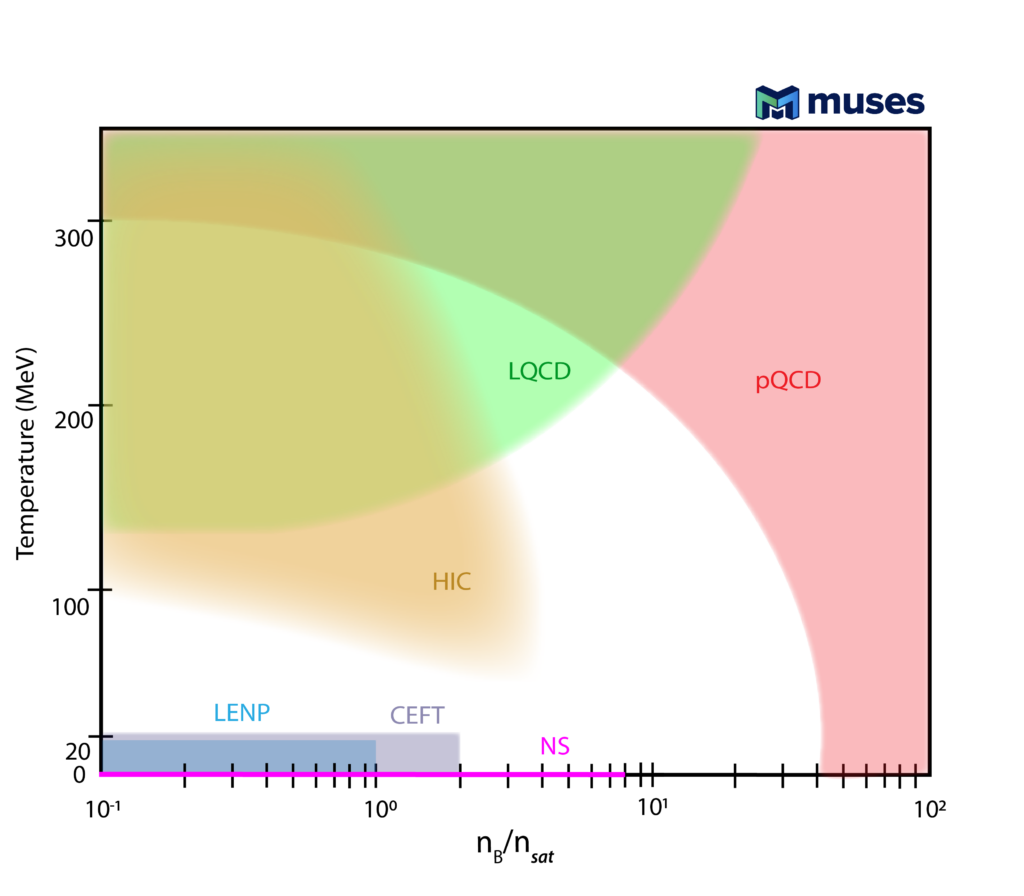
    This review aims at providing an extensive discussion of modern constraints relevant for dense and hot strongly interacting matter. It includes theoretical first-principle results from lattice and perturbative QCD, as well as chiral effective field theory results. From the experimental side, it includes heavy-ion collision and low-energy nuclear physics results, as well as observations from neutron stars and their mergers. The validity of different constraints, concerning specific conditions and ranges of applicability, is also provided

    BibTeX

    @article{MUSES:2023hyz,
        author = "Kumar, Rajesh and others",
        collaboration = "MUSES",
        title = "{Theoretical and experimental constraints for the equation of state of dense and hot matter}",
        eprint = "2303.17021",
        archivePrefix = "arXiv",
        primaryClass = "nucl-th",
        doi = "10.1007/s41114-024-00049-6",
        journal = "Living Rev. Rel.",
        volume = "27",
        number = "1",
        pages = "3",
        year = "2024"
    }

  • Resummed lattice QCD equation of state at finite baryon density: strangeness neutrality and beyond

    Resummed lattice QCD equation of state at finite baryon density: strangeness neutrality and beyond

    Submitted to ArXiV on February 11 2022, Phys.Rev.Lett. 126 (2021) 23, 232001

    Title

    Resummed lattice QCD equation of state at finite baryon density: strangeness neutrality and beyond

    Authors

    Szabolcs Borsanyi, Zoltan Fodor, Jana N. Guenther, Ruben Kara, Paolo Parotto, Attila Pasztor, Claudia Ratti, Kalman K. Szabo

    Abstract

    We calculate a resummed equation of state with lattice QCD simulations at imaginary chemical potentials. This work presents a generalization of the scheme introduced in 2102.06660 to the case of non-zero μS, focusing on the line of strangeness neutrality. We present results up to μB/T≤3.5 on the strangeness neutral line ⟨S⟩=0 in the temperature range 130\ MeV≤T≤280~MeV. We also extrapolate the finite baryon density equation of state to small non-zero values of the strangeness-to-baryon ratio R=⟨S⟩/⟨B⟩. We perform a continuum extrapolation using lattice simulations of the 4stout-improved staggered action with 8, 10, 12 and 16 timeslices.

    BibTeX

    @article{Borsanyi:2021sxv,
        author = "Bors\'anyi, S. and Fodor, Z. and Guenther, J. N. and Kara, R. and Katz, S. D. and Parotto, P. and P\'asztor, A. and Ratti, C. and Szab\'o, K. K.",
        title = "{Lattice QCD equation of state at finite chemical potential from an alternative expansion scheme}",
        eprint = "2102.06660",
        archivePrefix = "arXiv",
        primaryClass = "hep-lat",
        doi = "10.1103/PhysRevLett.126.232001",
        journal = "Phys. Rev. Lett.",
        volume = "126",
        number = "23",
        pages = "232001",
        year = "2021"
    }